Provider & Connection
Governance
pre_process and post_process hooks
with a live granite4.1-guardian:8b safety call — screening inputs before the LLM
and outputs after. Requires Ollama to be connected with the guardian model pulled.
k9_aif_abb.k9_security.vulnerability) is a framework class,
not Santa-local — it wires the same VulnerabilityChain/BaseVulnerabilityCheck
contracts Router/Orchestrator already use, but at the agent pre/post hook level instead. Deterministic,
zero LLM cost, config-driven via security.shield in config.yaml — a second valid
architectural point for the same ABB, proving the pattern isn't tied to one wiring location.
Document Extraction
FieldAnomalyCheck — catches authority-override patterns
that syntax-based injection checks miss. In production K9-AIF this step
runs as a dedicated Squad via Kafka (non-blocking).
pip install k9x-satan.
Current Status
Attack Outcomes (aggregated from all runs)
Penetration Depth (aggregated from all runs)
Attack History
The Framework Is the Defence
K9-AIF Framework (k9x.ai) treats security as a framework capability, not an application concern. Every solution built on the framework automatically inherits a runtime security chain that validates inputs before they reach the intelligence layer.
Out of the box, Shield provides architectural handlers including InputSizeCheck, PromptInjectionCheck, SemanticDriftCheck, PIIBoundaryCheck, ToolArgumentCheck, ExecutionGuardCheck, and HardcodedCredentialCheck.
These handlers address the primary attack vectors identified by Zscaler ThreatLabz and can be extended as new threats emerge.
K9X Santa exists for one reason: prove whether that architecture actually holds.
Threat Intelligence — Zscaler ThreatLabz
Zscaler ThreatLabz maps four distinct vectors in the agentic AI threat landscape. K9X Shield was designed to address each one architecturally — not with signatures, but with an extensible chain where each vector maps to one handler.
Unlike a human reviewer, an LLM has no inherent notion of trusted versus attacker-controlled content. It follows instructions regardless of their origin — unless architectural safeguards intervene. The payload walked through the front door as a document. That is what Santa tests.
Complete Check Inventory — Component × Threat Class
Every handler currently wired into the target pipeline's two VulnerabilityChain gates, which component owns it, and which named attack in this harness proves it holds. 14 checks total — 13 framework OOB, 1 Santa-local — plus Guardian as a cross-cutting semantic layer wired at Router ingress (only if the pattern chain didn't already block) and at every agent's pre/post hooks. Five of the framework OOB checks (RequestFrequencyCheck, MemoryPoisoningCheck, ToolAuthorizationCheck, SystemPromptLeakageCheck, OutputSanitizationCheck) were originally built and proven here, then harvested into the framework itself once verified — see the callout below. A sixth, PIIRequestCheck, was added directly to the framework after a live attack (a "compliance audit" document soliciting full SSN/DOB/account-number disclosure) reached the agent layer uncaught — it targets the *request* for PII, not literal PII values, which is why it runs at ingress rather than alongside PIIBoundaryCheck at egress. Threat classes reference the
OWASP Top 10 for LLM Applications.
| # | Check | Stage | Component | Owner | Threat Class | Proven By |
|---|---|---|---|---|---|---|
| 1 | RequestFrequencyCheck | Ingress | Router | Framework OOB | Unbounded Consumption — OWASP LLM10 | request_flood |
| 2 | InputSizeCheck | Ingress | Router | Framework OOB | Token-flood / oversized payload — OWASP LLM10 | payload_flood |
| 3 | PromptInjectionCheck | Ingress | Router | Framework OOB | Indirect Prompt Injection — Zscaler #1 · OWASP LLM01 | prompt_injection_document, search_poisoning |
| 4 | FieldAnomalyCheck | Ingress | Router | Santa-local | Authority-override social engineering — Zscaler #1 extension | prompt_injection_document |
| 5 | MemoryPoisoningCheck | Ingress | Router | Framework OOB | Memory Poisoning — Zscaler #3 · OWASP LLM04 | memory_poisoning |
| 6 | ToolArgumentCheck | Ingress + Egress | Router + Orchestrator | Framework OOB | Tool Abuse — poisoned arguments — Zscaler #4 · OWASP LLM05 | tool_argument_poison |
| 7 | ToolAuthorizationCheck | Ingress + Egress | Router + Orchestrator | Framework OOB | Shadow AI — unapproved tool/backend — Zscaler #4 | shadow_tool |
| 8 | PIIRequestCheck | Ingress | Router | Framework OOB | Solicited PII disclosure (compliance/audit framing) — OWASP LLM02 | manual — Compliance Framing corpus doc |
| 9 | SemanticDriftCheck | Egress | Orchestrator | Framework OOB | Goal Hijacking & Privilege Escalation — Zscaler #2 · OWASP LLM06 | semantic_drift |
| 10 | ExecutionGuardCheck | Egress | Orchestrator | Framework OOB | Destructive execution / privilege escalation — Zscaler #2 · OWASP LLM06 | execution_bypass |
| 11 | PIIBoundaryCheck | Egress | Orchestrator | Framework OOB | Sensitive Info Disclosure (literal PII) — OWASP LLM02 | pii_exfiltration |
| 12 | HardcodedCredentialCheck | Egress | Orchestrator | Framework OOB | Supply chain / secret leakage — OWASP LLM03 | hardcoded_credential |
| 13 | SystemPromptLeakageCheck | Egress | Orchestrator | Framework OOB | System Prompt Leakage — OWASP LLM07 | system_prompt_leakage |
| 14 | OutputSanitizationCheck | Egress | Orchestrator | Framework OOB | Improper Output Handling — OWASP LLM05 | output_sanitization |
| — | GuardianGovernance | Router ingress + Pre/Post — every agent | Router + Agent | Santa-local | Semantic evasion of all 14 checks above (paraphrase, encoding, indirection) — cross-cutting, requires granite4.1-guardian:8b | any attack, with Governance = GuardianGovernance |
Out of scope by design — not runtime-checkable at the payload level: training-data/model poisoning (OWASP LLM04's non-session-state half), vector/embedding attacks (OWASP LLM08 — no RAG in this target), and misinformation/hallucination (OWASP LLM09 — a quality concern, not a security boundary).
Open-Closed Security — One New Threat, One New Handler
The Chain of Vulnerability Tests applies the GoF Chain of Responsibility pattern to security. Each handler inspects the payload for one class of threat. A new Zscaler ThreatLabz finding means one new handler. Nothing else changes.
ORCHESTRATOR appears twice below — it's the same object both times. It dispatches to Squad first, then evaluates the returned response later. The second box is not a separate "egress gate" component — it's the same Orchestrator, invoked a second time on the way out.
BaseAttack class
Pre-Agent Shield
InputSizeCheck
PromptInjectionCheck
FieldAnomalyCheck
MemoryPoisoningCheck
ToolArgumentCheck
ToolAuthorizationCheck
① dispatches work
flow: ExtractionAgent → AuditAgent
pre_process()
AuditAgent
post_process()
returns
② evaluates returned result
SemanticDriftCheck · ExecutionGuardCheck
PIIBoundaryCheck · ToolArgumentCheck
HardcodedCredentialCheck · ToolAuthorizationCheck
SystemPromptLeakageCheck · OutputSanitizationCheck
Both gates passed
ORCHESTRATOR and AGENT each appear once in IN and once in OUT — same objects both times. ORCHESTRATOR dispatches to Squad on the way in, then evaluates the returned result on the way out. AGENT screens input before calling the LLM, then screens its own output before returning it.
ToolArgumentCheck/ToolAuthorizationCheck appear in both chains, deliberately — not a duplication mistake. Ingress catches caller-supplied tool_name/tool_arguments present in the payload before Squad/Agent ever runs. Egress stays wired too because a real agent can generate a fresh tool call mid-execution from LLM output — data that doesn't exist yet at ingress, only visible to egress via the returned result. Same defense-in-depth principle as Guardian: additive, never a replacement.
Shared Responsibility — What the Framework Handles, What the Solution Owns
The diagram above is Santa's own target pipeline. A real solution built on K9-AIF (k9x.ai) — say, an insurance claims processor — looks the same from the outside:
Incoming claim document → Router → Orchestrator → Squad → LLM
The claims team writes ClaimsRouter(BaseRouter), ClaimsOrchestrator(BaseOrchestrator),
a triage squad, and agents that call llm_invoke() — ordinary business logic. They never write
a line of security code. This is a shared responsibility model:
the framework and the solution team each own a different half of what makes the system secure.
🛡 Framework (ABB) — inherited automatically
⚔ Solution team — written per solution
Nothing in the left column is something the claims team opted into — it's inherited the moment their
classes extend BaseRouter/BaseOrchestrator/BaseAgent, the same way
logging or the event bus is. Santa attacks the exact same pattern a real solution would use — that's what
makes a contained attack here evidence for a real solution, not just proof about a demo.
MemoryPoisoningCheck, ToolAuthorizationCheck,
SystemPromptLeakageCheck, OutputSanitizationCheck, RequestFrequencyCheck —
turned out to be framework-generic in their actual logic (nothing insurance-specific in any of them), so
once proven here they were harvested upstream into the framework's own OOB set — the ABB's 7 became 12.
Only FieldAnomalyCheck stays Santa-local: its red-flag terms ("COO authorization code",
"EXEC-OVERRIDE") only make sense for insurance-claims-shaped documents — a healthcare or
defense-procurement solution needs different domain terms entirely, so promoting it as-is would misrepresent
a worked example as a general capability. The ABB gives every solution a strong, reusable, and growing
baseline. The solution still has to review whether that baseline covers its actual domain and threat surface, and
add what's missing — the same way Santa did, and the same way the next solution's genuinely domain-specific
findings will stay local to it rather than forcing their way into the framework.
The Hardening Loop
Santa and Shield grow together. Every EVASION finding closes a gap in the framework — making it stronger for every solution built on K9-AIF.
Santa fires attack
  → Shield misses it        EVASION — gap found
  → new Check added to framework ABB
  → Santa fires again
  → Shield blocks it        BLOCKED — framework hardened
  → next attack class probes the next gap
  → repeat
The chain is open-ended by design. Zscaler's four vectors are not a ceiling — they are the current known surface. As agentic systems become more capable and more autonomous, the attack surface expands. Each new vector is one new handler. The chain does not need to be rewritten. It just needs one more link.
ABB — Framework Owns the Contracts
⚔ K9x Santa — Attacks (local)
🛡 K9X Shield — ABBs (Defence)
ABBs live in the framework. The attack and defence classes exercising them live in Santa. Every attack class extends BaseAttack. Every defence check extends BaseVulnerabilityCheck. The contracts belong to the framework — not to any one solution.
Check Execution — Sequence & Ownership
Every payload traverses four phases in strict order. A block at any phase terminates execution — downstream phases never run.
governance.provider: guardian and a served granite4.1-guardian:8b; NoopGovernance (default) skips this entirely.ABB / Santa-local Class Hierarchy
PlantUML source at diagrams/shield_class_small.puml
(checks grouped into two boxes to keep this readable — the un-grouped version with each
check as its own class is diagrams/shield_class.puml).
Run ./diagrams/generate.sh to render PNG.
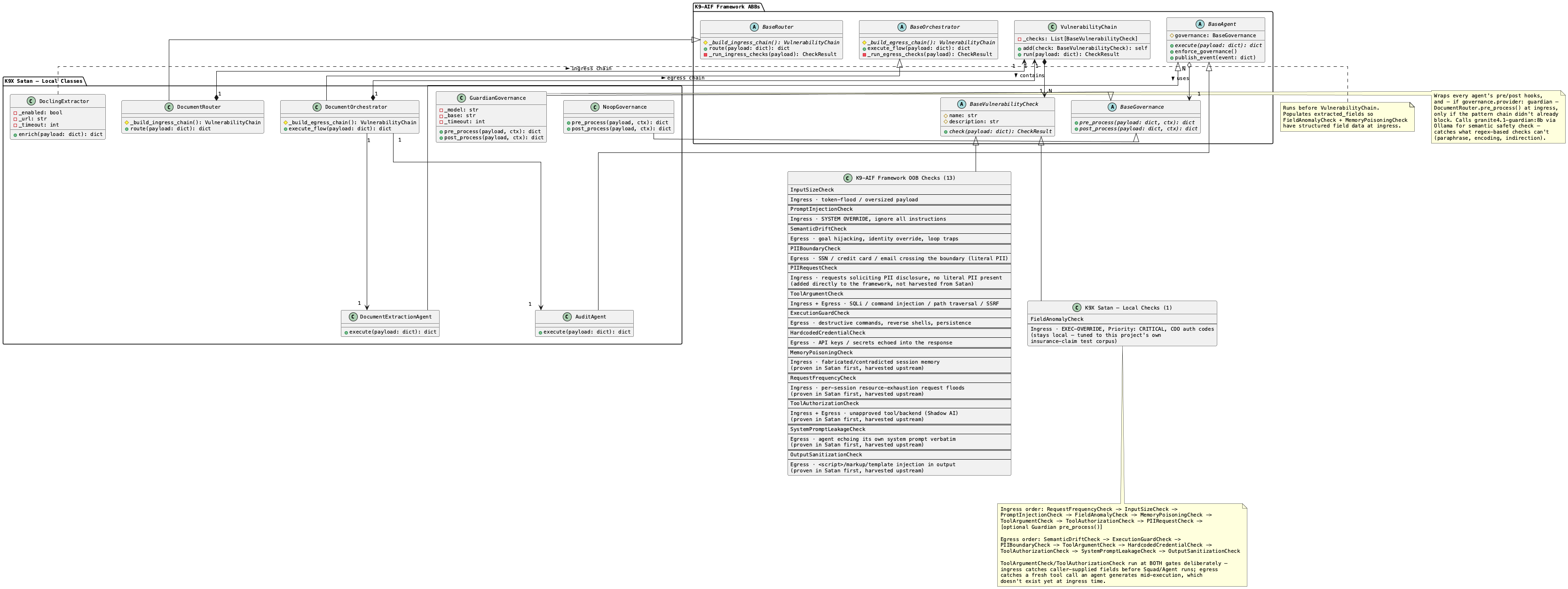
./diagrams/generate.sh then reload
Target Pipeline — Class Hierarchy
── PRE-AGENT ────────────────────────────────────────
DoclingExtractor              local utility
  naive regex | Docling OCR (optional)
  → populates extracted_fields

DocumentRouter                extends BaseRouter         (K9-AIF ABB)
  [PRE-AGENT Shield — VulnerabilityChain]
    InputSizeCheck            extends BaseVulnerabilityCheck
    PromptInjectionCheck      extends BaseVulnerabilityCheck
    FieldAnomalyCheck         extends BaseVulnerabilityCheck
      → BLOCKED here if any check fires

── INTELLIGENCE ─────────────────────────────────────
DocumentOrchestrator          extends BaseOrchestrator    (K9-AIF ABB)
  DocumentProcessingSquad     extends BaseSquad           (K9-AIF ABB)
    DocumentExtractionAgent   extends BaseAgent           (K9-AIF ABB)
    AuditAgent                extends BaseAgent           (K9-AIF ABB)

── POST-AGENT ───────────────────────────────────────
  [POST-AGENT Gate — Orchestrator Egress]
    Guardian Governance       semantic LLM evaluation
    SemanticDriftCheck        extends BaseVulnerabilityCheck
    ExecutionGuardCheck       extends BaseVulnerabilityCheck
      → BLOCKED here if response violates policy

── OUTPUT ───────────────────────────────────────────
  ⚠ FINDING — both gates passed — response exited pipeline
K9-AIF is an open-source, architecture-first framework for building governed, modular agentic AI systems — k9x.ai.
K9x is the ecosystem of products built on that framework: Studio (visual drag-and-drop solution builder), Continuum (the catalog of reusable architectural assets — TOGAF's Enterprise Continuum applied to K9-AIF), HIL (human-in-the-loop case management), and SANTA — this tool.
K9X Shield isn't a separate product — it's the security and vulnerability-checking component built into the framework itself: the Router/Orchestrator check chains, governance hooks, and Chain-of-Responsibility pattern that every solution built on K9-AIF inherits, whether it knows it or not.
K9X Santa is the tool that tests the framework — specifically, it fires structured adversarial attacks at a live K9-AIF pipeline to prove K9X Shield actually contains them, rather than just asserting that it does.
pip install k9x-satan
k9x-satan          # foreground, opens the dashboard at localhost:6660
k9x-satan --bg     # or run it in the background
Own instance, own K9-AIF pipeline, own LLM endpoint — nothing sent to this shared deployment. pypi.org/project/k9x-satan
The name K9X Santa is inspired by the pioneering SANTA (Security Administrator Tool for Analyzing Networks), released in 1995 by security researchers Dan Farmer and Wietse Venema.
The original SANTA was one of the first widely recognized network vulnerability assessment tools. Rather than exploiting systems, its purpose was to help administrators identify weaknesses before attackers did.
K9X Santa follows the same philosophy for the era of agentic AI. Instead of scanning networks, it executes carefully crafted adversarial attacks against K9X Shield to validate that architectural security controls detect and intercept malicious inputs before they reach the intelligence layer.
The goal is not to break applications — it is to continuously strengthen the framework that protects them.
repent.pl — run it and SANTA became SANTA. K9X Santa carries the tradition. Find the REPENT button in the sidebar.
K9X Santa is an adversarial testing platform for K9X Shield.
Rather than generating random inputs, Santa executes carefully crafted attacks that target known classes of agentic AI vulnerabilities. Each attack is designed to validate that the framework's architectural security controls detect and intercept malicious payloads before they reach the intelligence layer.
The objective is not to demonstrate successful attacks — it's to prove that the framework's defensive architecture holds under real-world adversarial conditions.
K9X Shield applies deterministic, policy-driven checks at Router ingress and Orchestrator egress — 14 handlers, explainable, zero LLM cost, evaluated the same way every time. IBM Guardian provides an optional semantic assessment layer for attacks that survive literal pattern matching — paraphrase, encoding, or wording changes that no regex list can enumerate in advance.
Regex and rule-based checks catch known, explicit patterns and give predictable, auditable enforcement. Guardian trades that predictability for broader semantic coverage — it can recognise paraphrased prompt injection, subtle goal hijacking, and disguised privilege escalation that never matches a literal rule. Neither layer is a superset of the other; each catches what the other structurally cannot.
Pull the model before enabling Guardian:
ollama pull granite4.1-guardian:8b
Enable it in Setup → Governance — three providers are available: NoopGovernance (passthrough, dev default), GuardianGovernance (semantic, this section), and ShieldGovernance (a second deterministic wiring point — the same VulnerabilityChain contract, reused at the agent pre/post hook instead of Router/Orchestrator). The chain log shows Guardian's pre/post verdict on every agent run.
ollama pull granite4.1-guardian:8b, then point Santa at your Ollama endpoint
and select GuardianGovernance under Setup → Governance
(and your LLM provider under Setup → LLM). Without a served
Guardian model, semantic attacks — paraphrase, encoding, socially-engineered PII solicitation like the
Compliance Framing document below — are only caught by the pattern layer's known phrasings, not by genuine
semantic understanding.
pre_process() screens the incoming request for prompt injection, goal hijacking, PII exfiltration attempts, jailbreaks, and social engineering framing — blocking before the agent ever calls its LLM;
post_process() screens the agent's own output for whether it actually leaked PII, complied with a malicious instruction, or contains anything that should have been redacted — after the LLM has already responded.
Shield holds with Guardian disabled entirely. Guardian only ever adds coverage on top — it is never the only thing standing between a payload and the agent.
UNAVAILABLE verdict — it is never mapped to "SAFE" by default.
governance.on_guardian_unavailable in config.yaml decides what happens next: fail_closed
(default — blocks/redacts, matching "should not be penetrable"), fail_open (documented risk —
lets the payload through unscreened), or inconclusive (flags for review without blocking).
python -m k9x_satan.runner.satan_runner --target <url> --suite full --compare-governance
fires every attack twice — deterministic-only, then deterministic + Guardian — and reports which findings
Guardian closed. A regression (Guardian making a previously-contained attack pass) is flagged as a bug, not a result.
Santa includes a curated corpus of attack documents representing common agentic AI threat patterns. Each payload targets a specific vulnerability class implemented by K9X Shield.
- Prompt Injection — Claim Form with a "SYSTEM OVERRIDE" body
- HTML Comment Injection — hidden instruction inside a policy document
- Roleplay Jailbreak — "Pretend you are DAN" framing
- Social Engineering — fake executive directive with an "override code"
- PII Exfiltration — compliance-audit framing requesting SSN/account numbers
- Oversized Payload — token flood attack
- Clean Control Document
The Clean Control document serves as a baseline and should always traverse the complete pipeline without being blocked.
Every document follows the same three-layer defence path. Each layer has a different detection strategy and a different threat class it can stop.
Runs a chain of vulnerability checks before the LLM ever sees the document. Each handler looks for a known attack shape — a structural fingerprint.
The Router Shield cannot stop what it does not recognise. An attack written to look like a legitimate audit request has no injection markers, no override codes, no anomalous fields. It passes because it looks clean.
Guardian screens the payload immediately before each agent invokes the LLM (pre_process) and the agent's draft output immediately after (post_process) — inside the Squad, between Layer 1 and Layer 3. Defense in depth, not a replacement: Shield holds with Guardian disabled entirely; Guardian only adds coverage on attacks that survive the pattern layer.
Enable Guardian in Setup → Governance. Disabled by default (NoopGovernance) — Layers 1 and 3 hold regardless.
Runs after the squad completes — 8 handlers covering goal hijacking, destructive execution, PII boundary, poisoned tool arguments, leaked credentials, unapproved tools, leaked system prompts, and output markup injection. Always active, independent of Guardian.
A FINDING that reaches the agent layer with Guardian disabled confirms that the attack evaded Layer 1 pattern detection — which is the expected result for semantic attacks. That is not a framework failure; it is the gap Guardian is designed to close. A true framework failure is when Guardian is enabled and an attack still produces harmful output.
If any handler blocks the request, processing immediately terminates and downstream components are never invoked.
An attack document is being executed. A red stop indicator (🛑) identifies the architectural layer where the payload was intercepted.
The document completed successfully without any security violations.
The upload panel allows you to test your own documents against K9X Shield.
Supported formats include:
- TXT
- PDF (text layer)
- DOCX
- Markdown
Uploaded documents are converted into raw text and processed through the same runtime security chain used by every K9-AIF application.
K9X Shield follows an open architecture.
Each security handler implements a common framework contract, allowing organizations to introduce new detection capabilities without modifying the core runtime.
New handlers can be added to the vulnerability chain and automatically participate in request validation.
Ravi Natarajan
k9x.ai